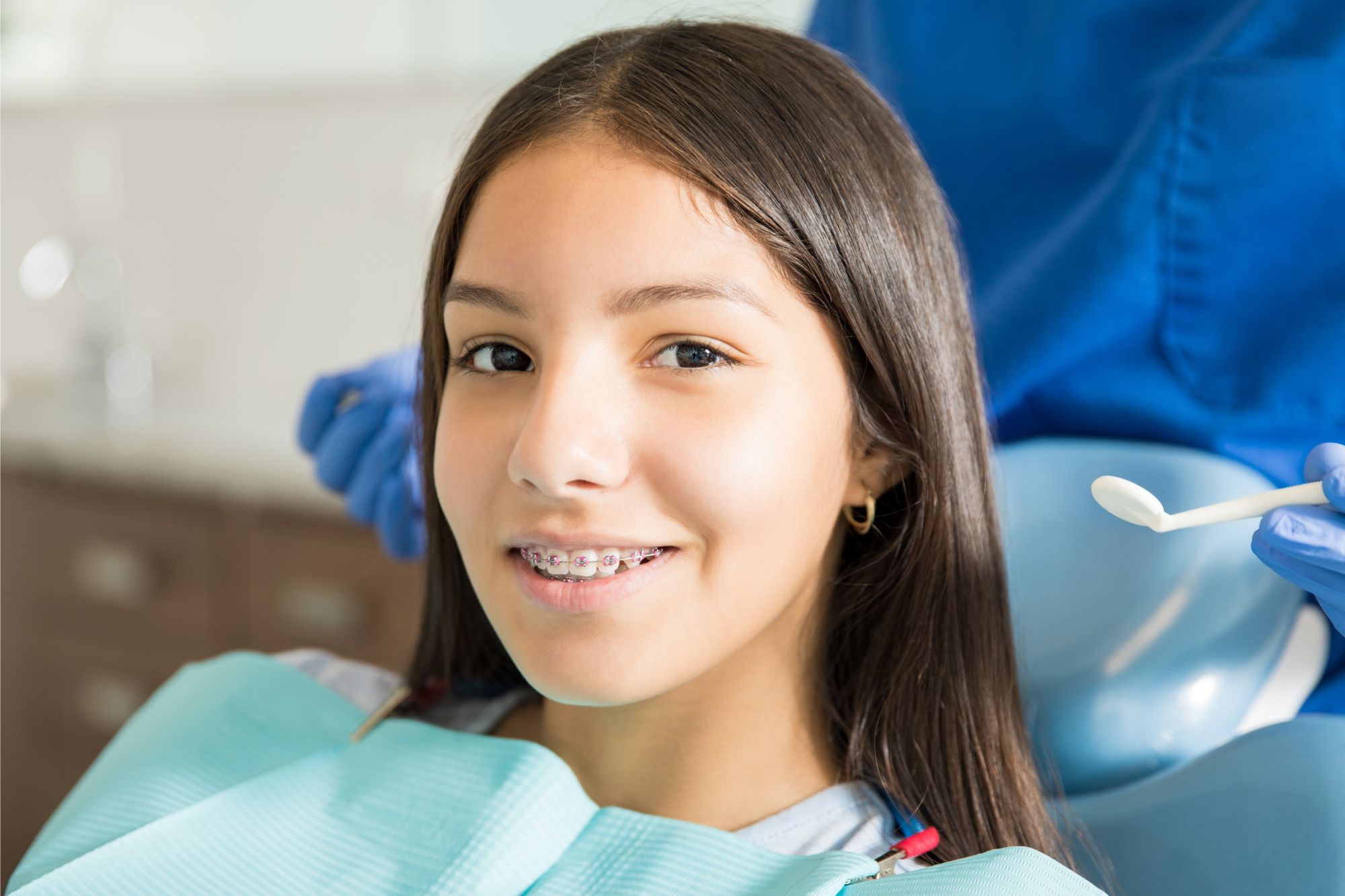

Most children who see an orthodontist at age 7 do not need braces at age 7. That surprises a lot of parents. The point of an early visit is not to start treatment, it is to find out whether anything needs correcting while your child is still growing, and for most kids the answer is that we watch and wait.
Early orthodontic treatment, often called Phase 1, is recommended only when a specific problem is developing that gets harder to fix later. Here is how that decision gets made.
Why Age 7 Is the Benchmark
According to the American Association of Orthodontics, children should be seen for their initial orthodontic evaluation at age 7. Yes, this is a young age and most of the teeth at this time are still baby teeth, but an evaluation does not mean you are ready to start braces or any form of treatment. This is the age where the front adult teeth are starting to grow in, so we want to make sure that they, along with the jaw bones, are developing and growing properly.
At Bucks Mont Orthodontics, Dr. Patel takes a very simple and conservative approach to orthodontic treatment. By evaluating children at age 7, Dr. Patel can address a problem that is starting to occur (or even before it occurs), or more likely put your child on a 4-6 month recall until they are ready for orthodontic treatment.
What We Check at an Early Evaluation
By seeing children for an orthodontic evaluation at age 7, Dr. Patel is able to ensure the baby teeth are healthy and maintaining the space for the adult teeth, the proper adult teeth are growing into your child’s mouth at the correct time, and that the jaw bones are growing properly to accommodate all of the adult teeth.
Five Signs That Point Toward Early Orthodontic Treatment
There are 5 findings at this age that would warrant Phase 1 orthodontic treatment. These findings are as follows:
- Posterior cross-bite, an indication that the top jaw may be too small. You may notice your child’s jaw shifting to one side when they bite down.
- Anterior cross-bite or an underbite, where the bottom front teeth sit in front of the top ones when the mouth is closed.
- Severe crowding, where adult teeth are coming in overlapped or twisted because there is not enough room for them.
- Adult teeth not growing into their correct position, including teeth that erupt well out of line or do not appear when expected.
- Protruding front teeth that are at risk of trauma, meaning top front teeth that stick out far enough to be chipped or knocked in a fall.
There is a window for when these findings can be corrected, but early evaluation will provide the best results and ultimately the most conservative treatment long-term.
Those five are the findings that specifically point toward treating early. For a fuller picture of what tends to show up at this age, see our rundown of the most common orthodontic issues in kids ages 7 through 10.
What Happens If You Wait
For most children, waiting costs nothing. If none of those five findings is developing, there is no benefit to starting treatment early, and we simply keep an eye on things until more adult teeth have come in.
Where timing matters is with the findings above. Several of them are easier to correct while the jaw is still growing, because we can guide that growth instead of working around it after it has finished. A narrow upper jaw is the clearest example. Widening it is a routine correction in a growing child and a more involved one in a teenager whose growth has slowed.
That is the whole reason for the age 7 benchmark. It is not about starting early for its own sake. It is about not missing the window on the handful of problems where timing genuinely changes the outcome.
Early Orthodontic Treatment FAQs
Does my child need braces at age 7?
Most children do not. The age 7 visit is an evaluation, not the start of treatment. In most cases we place a child on a 4 to 6 month recall and treat later, once more adult teeth have come in.
What is Phase 1 orthodontic treatment?
Phase 1 is a short course of early treatment recommended only when a specific problem is developing that is easier to correct while a child is still growing. Most children never need it.
What if my child is older than 7?
It is not too late. Age 7 is a benchmark for catching a small number of problems at the right time, not a deadline. Children, teens and adults are all treatable.
Will my child still need braces later if they have early treatment?
Often yes. Phase 1 corrects one specific problem while the jaw is growing. Many children still have a second round of treatment once all the adult teeth have come in.
Contact Bucks Mont Orthodontics Today
If you live in Doylestown, Warminster, or Warrington, and your child has not been seen for an orthodontic evaluation, please give us a call for a complimentary examination at 215-398-0794. Even if your child is older than 7, it’s never too late.